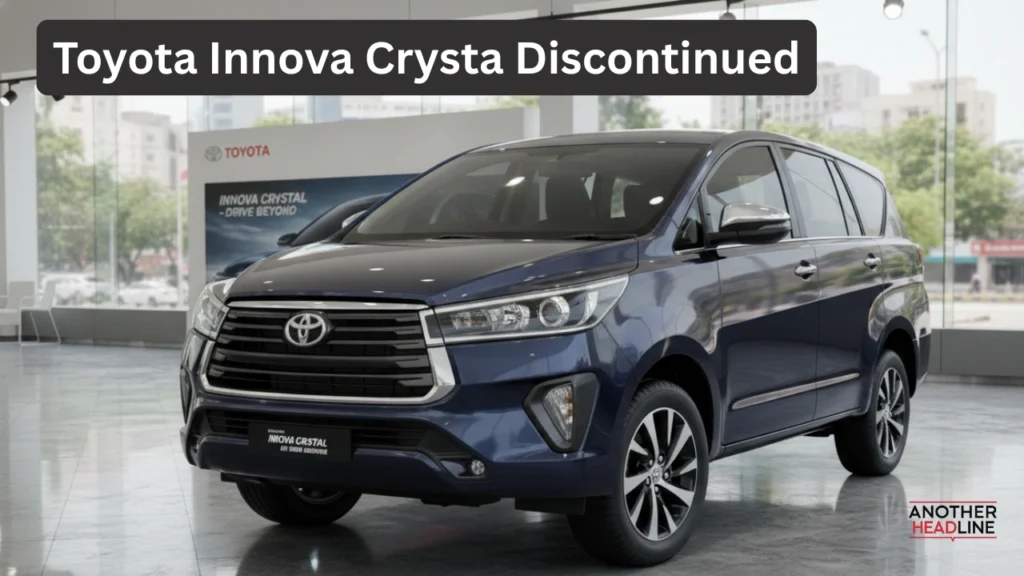
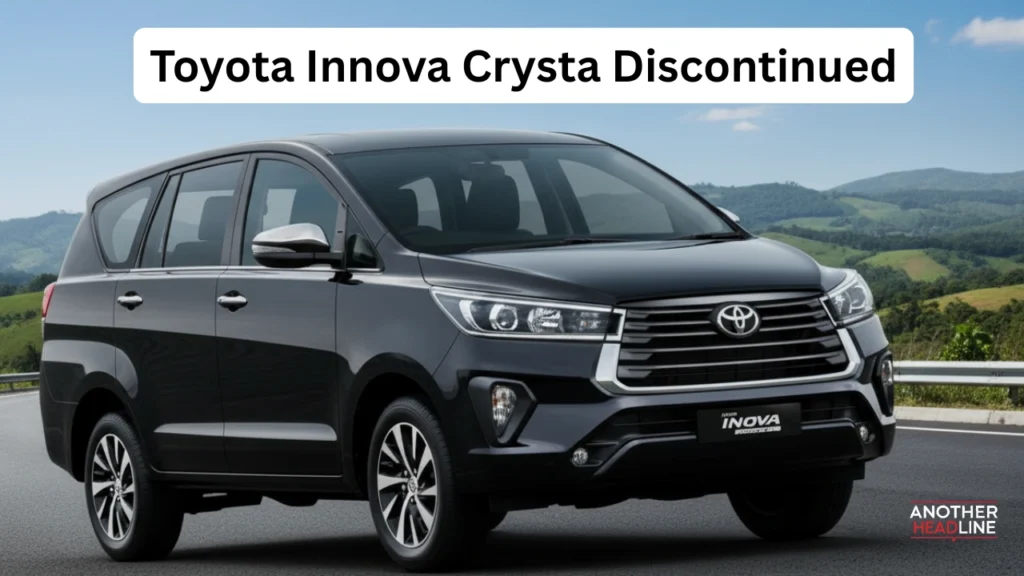
Toyota Innova Crysta Discontinued: The Toyota Innova Crysta, a nameplate that has dominated India’s premium MPV space for nearly two decades, is expected to be discontinued around March 2027. The move is not driven by weak demand or product failure, but by India’s upcoming Corporate Average Fuel Economy (CAFE) Phase 3 norms, which significantly tighten fleet-level CO₂ emission targets for automakers.
While Toyota has not officially confirmed the discontinuation, multiple industry reports and regulatory realities point towards the end of the diesel-only, ladder-frame Crysta as India transitions toward cleaner mobility solutions.
Why the Toyota Innova Crysta Is Under Pressure
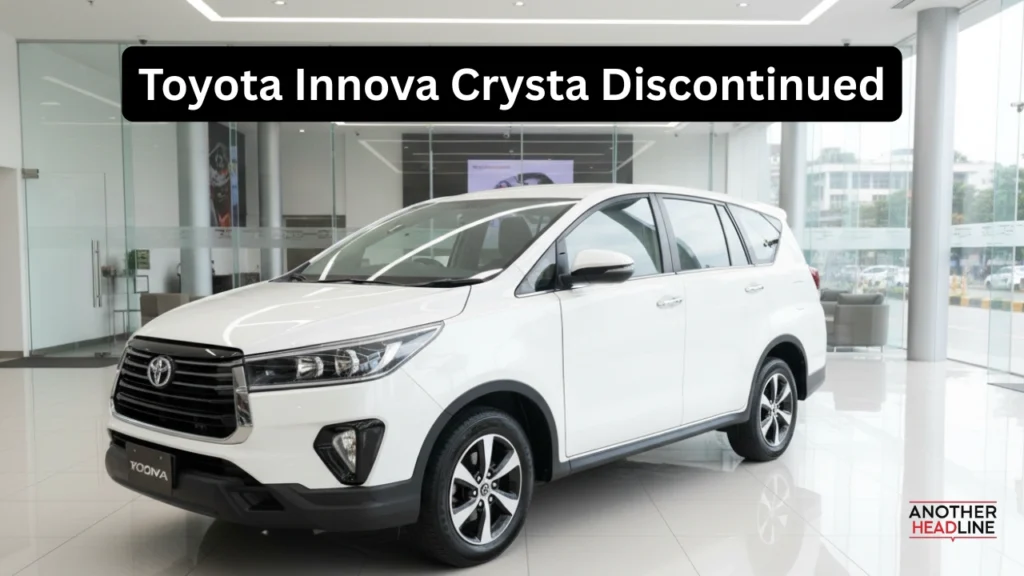
The Innova Crysta remains popular among:
- Large families
- Fleet and taxi operators
- High-mileage users
However, its mechanical strengths are also its biggest regulatory weakness.
Also Read
Key factors working against the Crysta:
- Heavy body-on-frame construction
- Large 2.4-litre diesel engine
- Rear-wheel-drive layout
- Sold only with manual transmission
- No hybrid or electrified option
Under stricter emissions accounting, these traits push the vehicle higher on the CO₂ curve, making compliance increasingly expensive for Toyota.
What Are CAFE 3 Norms and Why They Matter?
CAFE (Corporate Average Fuel Efficiency) norms:
- Apply at the manufacturer level, not individual models
- Measure average CO₂ emissions of all passenger vehicles sold
- Are weight-based, allowing heavier vehicles slightly higher limits
However, CAFE 3 (effective April 2027) brings:
- A sharp reduction in permissible fleet-average CO₂ levels
- Higher penalties for manufacturers with emission-heavy portfolios
- Greater reliance on hybrids and EVs to balance emissions
In simple terms:
- Each diesel Innova Crysta sold raises Toyota’s fleet emissions
- That increase must be offset by selling more low-emission vehicles
Why Hybrids Are Toyota’s Strongest Weapon
Toyota’s India strategy increasingly revolves around strong hybrid technology, and CAFE 3 only reinforces this direction.
Advantages of hybrids under CAFE:
- Eligible for “super credits”
- Each strong hybrid counts more than once in fleet calculations
- Pulls down average emissions far more efficiently
Toyota’s hybrid advantage includes:
- Innova Hycross (strong hybrid option)
- Hybrid SUVs and sedans in collaboration with Maruti Suzuki
- Proven self-charging hybrid tech with real-world fuel efficiency
From a regulatory standpoint:
- A hybrid Innova Hycross helps compliance
- A diesel Innova Crysta makes compliance harder
This imbalance makes it economically difficult to justify continuing the Crysta in its current form.
Timeline: Why the Crysta Survived Longer Than Planned
- Originally expected to exit around 2025
- Production extended due to:
- Strong demand, especially from fleet buyers
- Supply constraints affecting the Innova Hycross
- Final phase-out now expected around March 2027
Toyota has publicly stated it will not comment on future products, but continues to emphasise its “multi-pathway approach” to sustainable mobility.
Toyota’s MPV Strategy Going Forward
Toyota has already drawn a clear line within the Innova family:
- Innova Crysta
- Diesel-only
- Ladder-frame
- High durability
- Favoured by commercial and heavy-use buyers
- Innova Hycross
- Monocoque chassis
- Petrol and strong hybrid powertrains
- Lower emissions
- Positioned for private buyers
As regulations tighten, this split becomes harder to sustain, with hybrids emerging as the long-term solution.
Will the Crysta Have a Replacement?
- No direct replacement planned
- No current body-on-frame diesel MPV rivals in India
- Mahindra and Tata:
- Have strong diesel engines
- Do not offer Innova-style MPVs
Potential developments:
- Hyundai Staria being evaluated for India
- Heavy localisation could make it viable
- Powertrain strategy (diesel vs hybrid) still unclear
The Crysta’s exit may reopen the MPV conversation for rivals who have focused heavily on SUVs.
Impact on the Indian Car Market
The discontinuation of the Innova Crysta would:
- Mark the end of an era for diesel premium MPVs
- Reinforce the shift toward hybrids and electrification
- Leave a temporary vacuum in the rugged MPV segment
- Signal how regulations, not demand, are shaping product decisions
Final Verdict
The Toyota Innova Crysta is not being phased out because it failed, but because India’s regulatory framework is evolving faster than diesel technology can adapt. Under CAFE 3 norms, every model must justify its existence not just on sales, but on emissions math. As Toyota doubles down on hybrids, the Crysta’s role becomes harder to defend. By 2027, India will likely bid farewell to one of its most iconic MPVs—making way for a cleaner, more electrified future.